Los Angeles County's median listing price has plunged to $991,500 in April 2026, down more than $140,000 from its May 2024 peak of $1.13 million—marking the lowest level since early 2023. This isn't a seasonal blip. It's a sustained correction that's been grinding away for nearly two years, erasing the frenzied gains that pushed prices above the million-dollar threshold. After years of pandemic-era euphoria, LA's housing market is experiencing what happens when gravity finally reasserts itself—and buyers, for the first time in years, have options.
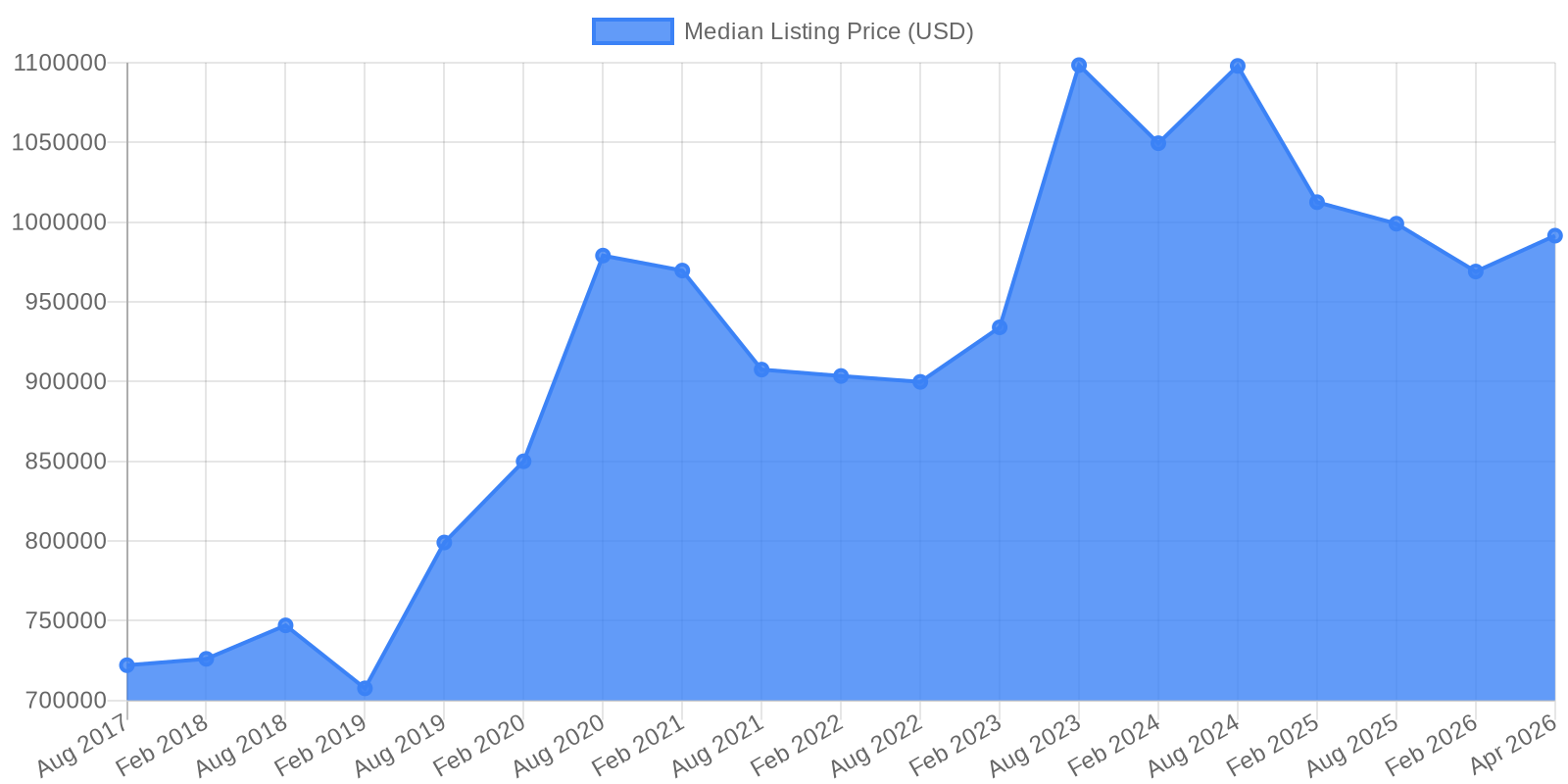
Median listing prices in Los Angeles County surged from $850,000 in early 2020 to a peak of $1.13 million in May 2024, then declined steadily to $991,500 by April 2026—the lowest level since early 2023.
The data tells a story of two distinct chapters. From mid-2020 through mid-2024, Los Angeles experienced an extraordinary run: prices rocketed from around $850,000 to over $1.1 million in just four years, driven by ultra-low mortgage rates and relentless demand. The peak came in May 2024 at $1,132,472. But since then, the market has been in near-constant retreat. Prices dropped sharply through late 2024, hitting $970,000 by December, then briefly stabilized in early 2025 before resuming their slide. By April 2026, listings were down 12.5% from the year-ago level. The volatility is striking: month-to-month swings of $50,000 or more became common, reflecting both seller uncertainty and buyer reluctance.
The correction tracks closely with nationwide trends documented by housing analysts. California's home price gains shrank 73%—a 1.9% increase in 2025 versus averaging 7.2% increases throughout 2019 to 2024, making it one of the sharpest slowdowns nationally. The culprit? Inventory growth—October 2025 marked the 24th straight month of year-over-year inventory growth, with homes on the market 15% higher than a year earlier, according to Ramsey Solutions' 2026 forecast. More supply meant buyers didn't need to bid aggressively. Meanwhile, the average 30-year fixed mortgage rate stood at 6.15% in late December 2025—the lowest level of 2025, down from 6.91% a year earlier, per LA Metro Home Finder. But even with rates easing, demand remained tepid as economic uncertainty kept potential buyers cautious.
What's driving this prolonged downturn? The fundamentals have shifted dramatically from the pandemic years. The housing market dynamic shifted mid-June of 2025 when lower mortgage rates stimulated demand and the inventory growth couldn't be sustained, notes HousingWire's analysis. But Los Angeles faces unique headwinds. The lock-in effect—homeowners trapped by sub-4% mortgages they locked in during 2020-2021—has kept many would-be move-up buyers frozen. J.P. Morgan expects home prices to stall at 0% nationally in 2026, noting the U.S. housing shortage at around 1.2 million homes is significantly below other market estimates, per J.P. Morgan's outlook. Regional variation matters: house prices are falling the most along the West Coast and Sun Belt, where there remains a glut of new homes following the pandemic-era construction boom. LA's high-price baseline—still nearly double the national median—makes it especially sensitive to affordability pressures. When prices climbed past $1.1 million, many middle-class buyers simply got priced out, leaving a thinner pool of qualified purchasers.
The trajectory ahead remains uncertain, but the correction may not be over. While California's median home price is forecast to rise 3.6% to $905,000 in 2026 statewide according to C.A.R.'s forecast, LA County's listing prices sit well above that figure, suggesting further downward pressure. Experts forecast 1-4% price appreciation in 2026, with most forecasts predicting modest appreciation rather than significant declines per Borges Real Estate. But that assumes rates stay near 6% and inventory doesn't surge further. For buyers who've been sidelined, this is the most negotiating power they've had in five years. For sellers who bought at the peak, it's a sobering reminder that real estate doesn't only go up.