Los Angeles County's housing market is experiencing something extraordinary: demand has almost completely evaporated. The Market Hotness Demand Score, which tracks average listing views on Realtor.com relative to other markets, plunged to just 13.00 in April 2026—down from 86.14 in August 2017, an 85% collapse. This isn't just a correction. It's a structural breakdown in buyer interest that's left LA with the weakest housing demand in nearly a decade. Here's what I think is happening: after years of being priced out, buyers have simply stopped looking. They're not waiting for the perfect moment anymore—they've left the market entirely.
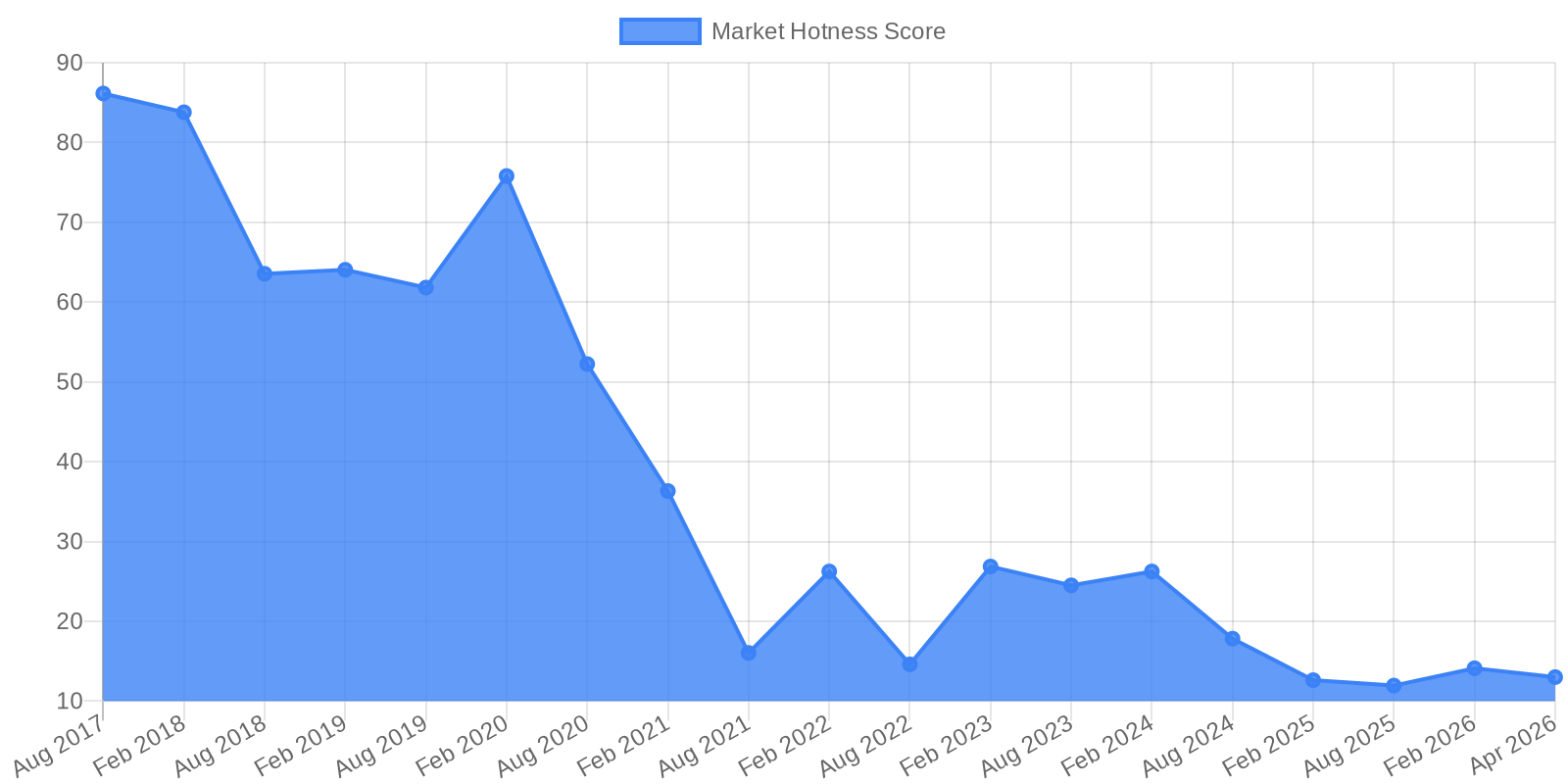
Market Hotness Demand Score for Los Angeles County, measuring average listing views on Realtor.com relative to other U.S. markets. A score of 100 represents the highest relative demand, while lower scores indicate weaker buyer interest. Data from Realtor.com via Federal Reserve Economic Data (FRED).
The chart shows three distinct chapters of LA's housing story. From mid-2017 through early 2018, demand held strong in the mid-80s range, reflecting the tail end of the post-recession recovery. Then came the first major decline: demand fell to the low 60s by late 2018 and stayed depressed through most of 2019, averaging around 61. A brief rebound pushed the score back to 81.62 by January 2020, but the pandemic obliterated that momentum. Between April 2020 and June 2021, demand cratered from 87.62 to 17.08—a 70-point freefall in just 14 months as forbearance programs, eviction moratoriums, and stimulus checks created a bizarre frozen market. Demand bounced modestly into the low-to-mid 30s during 2022's brief recovery, then collapsed again. By February 2025, it had hit 12.62, the lowest reading in the entire dataset. April 2026's score of 13.00 represents a market where buyers aren't just cautious—they've disappeared.
What explains this meltdown? Sales volume remained flat in 2025 and is now trending downward in 2026, suggesting the problem isn't just lack of interest but lack of transactions. Mortgage rates averaged 6.05% in February 2026, down from 6.84% a year prior, which should have sparked renewed activity—but it didn't. Year-to-date, sales volume in LA County is down 6% from 2025 as of February 2026. Meanwhile, median condo prices fell 4.5% year-over-year, and in January and February, fewer than 2,000 condos were sold—the worst start to a year since 2005. The culprit isn't just affordability. The demand score represents a market's average listing views on Realtor.com relative to other markets, meaning LA buyers aren't even window-shopping anymore. The combination of stubborn prices (still hovering near $900,000 countywide), elevated rates, and economic uncertainty has created a buyer strike. People who would normally browse listings on a Sunday afternoon have stopped clicking.
The implications are profound. Unlike the 2008 crash, where foreclosures flooded the market and prices collapsed, this downturn features stable prices alongside vanishing demand. In LA County, it only took 32 days to sell a home in February 2026, suggesting well-priced homes still move—but there are far fewer buyers competing for them. For-sale inventory in the Los Angeles metro area increased 28% in 2024 and another 12% in 2025, yet prices haven't buckled because sellers refuse to capitulate. This standoff can't last forever. Either buyers return as rates fall further, or sellers will be forced to cut prices more aggressively to attract the shrunken pool of shoppers. The wild card is timing: a complete recovery to around 110,000 annual home sales will likely occur in the years following 2028, suggesting the current malaise could drag on for years. For now, LA's housing market exists in a strange limbo—prices stable, but demand historically weak—where the only certainty is that something has to give.