Los Angeles County's homeownership rate cratered to 48.36% in 2016—the lowest point in more than half a century. That means fewer than one in two households owned their home, a dramatic collapse from the 51.75% rate just seven years earlier. This wasn't just a statistical blip. It represented a fundamental shift in how Angelenos live, marking the culmination of a housing crisis that pushed homeownership further out of reach than at any time in modern memory. The data, tracked by the U.S. Census Bureau's American Community Survey, tells the story of a region where the dream of owning a home became increasingly unattainable for working families.
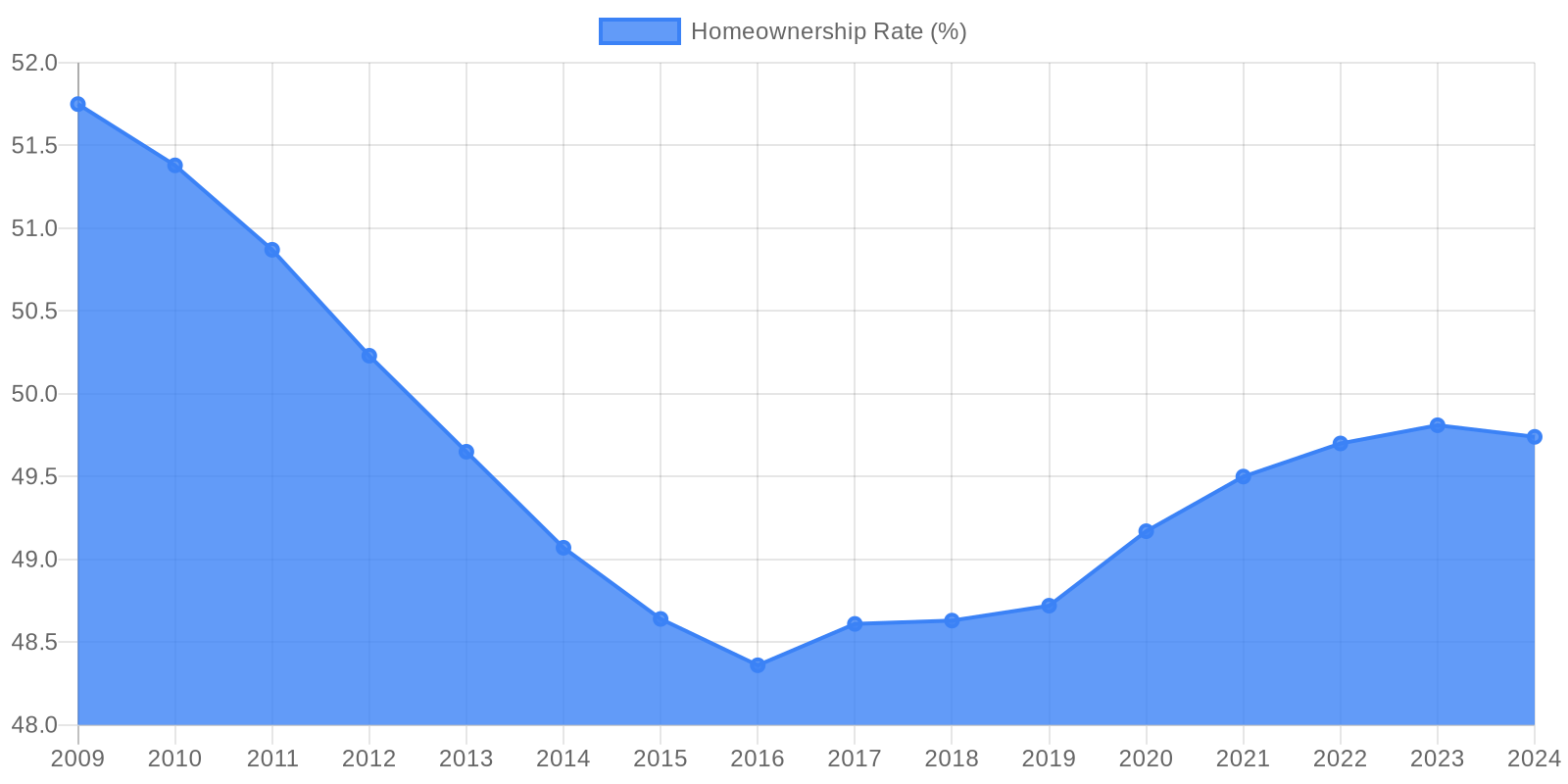
Homeownership rate in Los Angeles County fell steadily from 2009 to 2016, hitting a half-century low of 48.36%, then recovered modestly to 49.74% by 2024—still well below pre-recession levels.
From 2009 through 2016, LA County's homeownership rate dropped steadily, shedding 3.39 percentage points over seven years. The decline was relentless: 51.75% in 2009, 50.23% by 2012, 48.64% by 2015, bottoming out at 48.36% in 2016. Then something changed. The rate ticked up modestly to 48.61% in 2017 and continued a slow, grinding recovery: 49.17% by 2020, 49.70% by 2022, peaking at 49.81% in 2023 before edging down slightly to 49.74% in 2024. The recovery has been real but painfully slow—after eight years of gains, the county still hasn't reclaimed the homeownership levels it had in 2013, let alone 2009.
What drove this collapse? The Great Recession delivered the initial blow, but LA's housing crisis had deeper roots. According to recent research from the USC Lusk Center, housing production in LA County "declined sharply over the decades, from more than 70,000 units annually in the 1950s to less than 15,000 per year in the 2010s." At the same time, rent burden remained elevated throughout the 2010s, with 58% of renters considered rent-burdened in 2010. The squeeze was on both ends: not enough homes were being built, and those who couldn't buy were spending an unsustainable share of income on rent, making it harder to save for a down payment. The result was a self-reinforcing cycle that locked more Angelenos into renting even as economic recovery took hold after 2010.
The modest rebound since 2016 reflects economic improvement, but it's bumping up against structural barriers that won't budge. Home prices in LA County hit $910,000 as of March 2026—roughly 2.5 times the national median—while California's statewide shortage remains at an estimated 3 million housing units as of 2025. Even with mortgage rates declining and job growth steady, the math doesn't work for most first-time buyers. The USC report notes that homeownership in the county "has declined to 45%, the lowest level in more than 50 years"—though this figure appears to reflect a more recent snapshot and methodology than the Census five-year estimates. What's clear is that even after years of economic expansion, LA remains a city where owning a home is the exception rather than the norm.
The chart tells a story of loss that hasn't been fully recovered. Homeownership in LA peaked before the financial crisis, collapsed through the worst housing market in generations, and has clawed back only about half the ground it lost. The rate sits barely above where it was in 2020, during a pandemic. For millions of Angelenos, the gap between renting and owning isn't closing—it's just stabilizing at a new, lower normal. Unless housing production doubles or triples and prices moderate significantly, that 48-50% range may be LA's reality for years to come.