Los Angeles issued 571 building permits for accessory dwelling units in April 2026, marking one of the highest monthly totals in the city's records and a 3.6% increase from the 551 permits issued in April 2025. This isn't a fluke—it's the culmination of a remarkable six-year expansion that has transformed ADUs from a niche housing solution into a mainstream response to California's affordability crisis. The April figure also jumped 2.7% from March 2026's 556 permits, extending an upward trend that shows no signs of slowing as homeowners tap into streamlined permitting rules and rental income potential averaging $2,200 to $4,200 per month across the city.
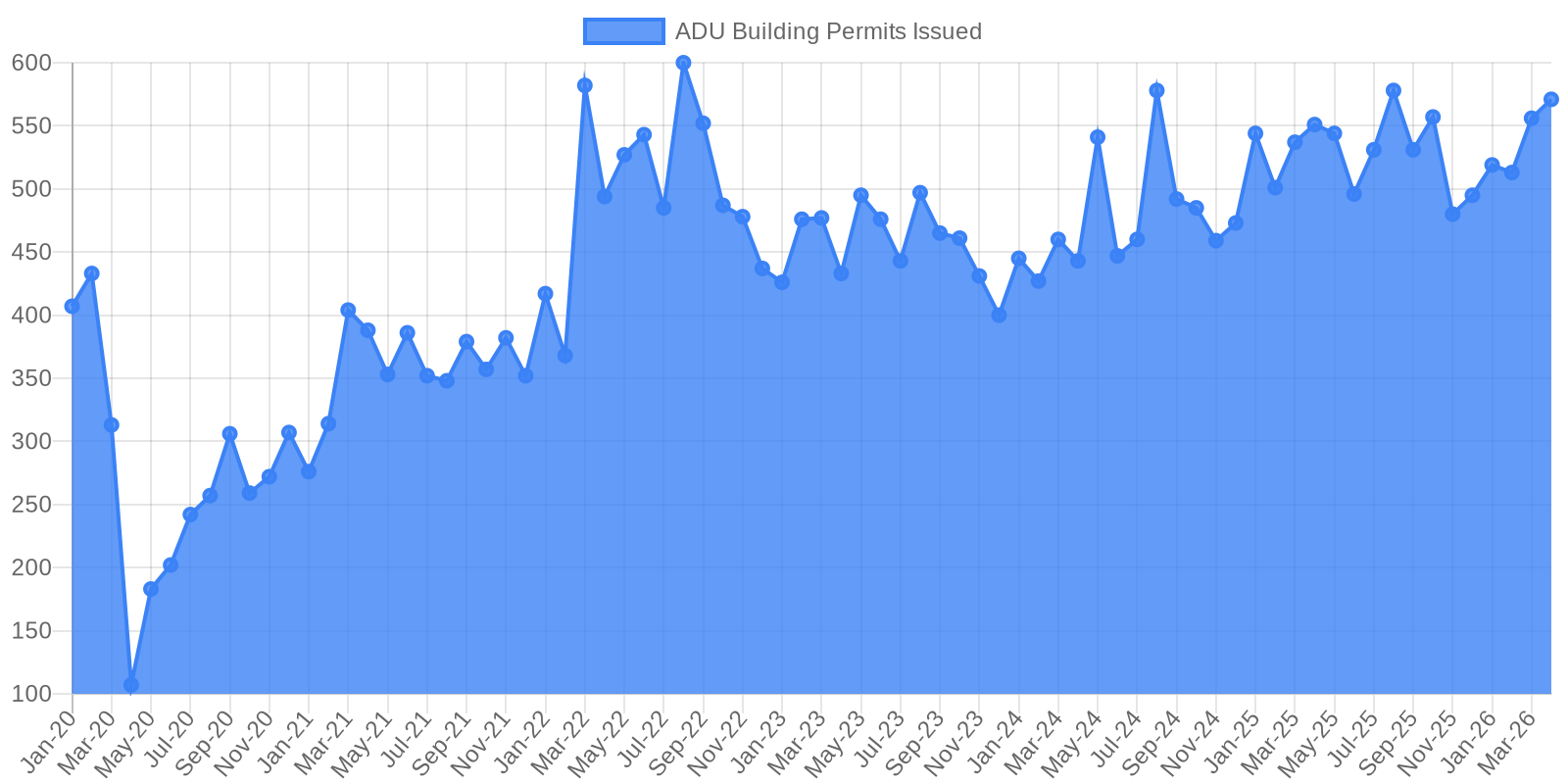
Monthly ADU building permits in Los Angeles surged from a pandemic low of 107 in April 2020 to 571 in April 2026, reflecting sustained growth driven by policy reforms and rental income potential in a city facing historic housing shortages.
The chart data reveals a dramatic arc since early 2020. Permit activity crashed to just 107 in April 2020 as the pandemic hit, but bounced back steadily through 2021, averaging around 360 per month. The real inflection came in early 2022: permits surged to 582 in March and topped 600 in August, signaling a structural shift in homeowner behavior. From 2022 through 2024, monthly issuance hovered between 400 and 600 permits, with occasional dips but no prolonged downturns. Then 2025 brought a new baseline: every month from January through October averaged above 530 permits, and the trend continued into 2026. January through April 2026 averaged 540 permits per month, compared to 452 for the same period in 2023 and 444 in 2024. The six-year trajectory is unmistakable—Los Angeles has nearly doubled its ADU permit production from pre-pandemic levels, and the momentum is accelerating.
This growth isn't happening in a vacuum. It's being driven by sweeping legislative changes that took effect January 1, 2026, including SB 543, which mandates cities approve or deny ADU applications within 60 days, and AB 1332, which requires pre-approved plan libraries that cut permitting timelines to as little as 21 to 30 days in Los Angeles. The removal of owner-occupancy requirements for most ADUs and JADUs means homeowners can now build and rent out both their primary residence and the ADU simultaneously, unlocking rental income streams that were previously restricted. Meanwhile, AB 818 and AB 462 have fast-tracked ADU approvals for disaster recovery, with fire-affected homeowners in LA County now qualifying for 10-day permit approvals and the ability to occupy an ADU before the main house is rebuilt. These aren't just policy tweaks—they're designed to activate dormant housing capacity on thousands of single-family lots across the city.
The ADU surge is a direct response to Los Angeles' deepening housing shortage and affordability crisis that excludes 82% of California households from buying a median-priced home. In 2025, Los Angeles issued just 8,714 residential building permits for all housing types combined, keeping production near a 10-year low even as rents climbed 28% since March 2020. Traditional multifamily construction has slowed dramatically, with new apartment deliveries down 70% in recent years due to high interest rates, labor shortages, and restrictive zoning. Against that backdrop, ADUs represent the path of least resistance: they're exempt from density limits, impact fees, and parking requirements under state law, and they add housing units on lots that already have utilities and infrastructure. With the median listing price at $1.175 million and rental demand outpacing supply, homeowners are increasingly viewing ADUs not as backyard experiments but as financial necessities—a way to generate $2,000 to $4,200 in monthly rent, offset mortgage payments locked in at 6.5% or higher, and build long-term equity. The April 2026 numbers suggest that policy, economics, and necessity have finally aligned, turning accessory homes into Los Angeles' most scalable housing solution.