South Valley vs North Valley — LA's single-family construction tells two stories
South Valley issued 361 single-family and duplex permits in 2025 versus North Valley's 239. LA's citywide rebound to 1,775 permits was driven by 600 fire rebuilds, masking continued construction weakness.
Wednesday, June 3, 2026· By Jason York
Los Angeles' two Valley regions are moving in opposite directions when it comes to new single-family home and duplex construction. In 2025, South Valley issued 361 new building permits while North Valley managed just 239—a gap of 122 permits that tells a story of diverging development priorities across LA's sprawling suburban landscape. What's remarkable isn't just the size gap, but its consistency: South Valley has outpaced North Valley every year since 2021, often by margins exceeding 50%. This isn't a fluke or a one-year anomaly. It's a structural split in where LA is actually building homes for families who want yards and garages. And in a city desperately short on housing, these numbers reveal which neighborhoods are pulling their weight—and which aren't.
Annual building permits for single-family homes and duplexes in South Valley versus North Valley (2020-2025). South Valley has consistently outpaced North Valley since 2021, with the gap widening to 122 permits by 2025.
The data shows South Valley building permits peaked in 2022 at 379 units before settling into a stable range between 323 and 368 permits annually through 2025. North Valley tells a bleaker story: after hitting 332 permits in 2021, issuance collapsed to 258 in 2022, then to 216 in 2023, and has flatlined around 240 permits for the past two years. The gap between the two regions has grown steadily wider—from just 27 permits separating them in 2020 to 122 permits in 2025. Over the six-year period tracked, South Valley issued a total of 2,019 permits compared to North Valley's 1,561—a difference of 458 homes, or 29% more construction activity in the South.
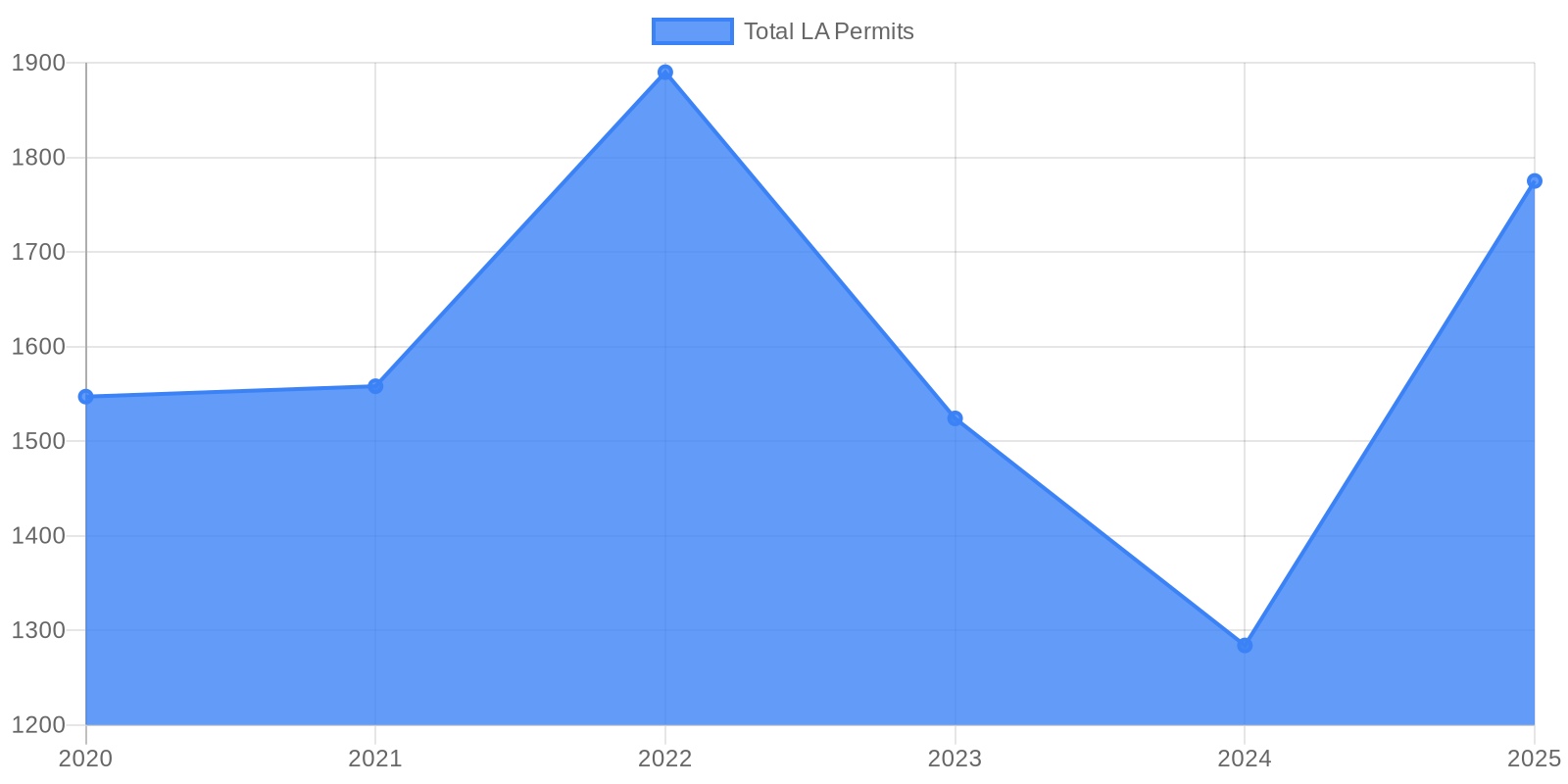
Total single-family home and duplex building permits issued across Los Angeles (2020-2025). The 2025 spike to 1,775 permits was driven by approximately 600 fire rebuild permits in Pacific Palisades and Altadena.
The Valley divide fits into a citywide pattern of housing construction that's been stuck in the doldrums. Total single-family home and duplex permits across Los Angeles peaked at 1,890 in 2022, then fell sharply to 1,524 in 2023 and bottomed out at just 1,284 in 2024—a 32% collapse in just two years. The 2025 rebound to 1,775 permits looks encouraging until you understand what drove it: roughly 600 of those permits were for fire rebuild projects, primarily in Pacific Palisades and Altadena. According to reporting by Westside Current, Pacific Palisades alone saw 595 new construction permits in 2025, "a 1252.3% increase over the prior year," driven entirely by fire recovery. Strip out those emergency rebuilds and 2025 would have been another dismal year—perhaps the worst on record.
Why the sustained weakness in North Valley while South Valley holds steady? Geography is part of it: data shows the South and West Valley regions lead in total permits across Los Angeles. But the real culprits are economic headwinds hitting all of LA. High interest rates, economic uncertainty, tariffs that spike construction material costs, and immigration restrictions that shrink the labor pool have made new housing construction increasingly unviable, according to Urbanize LA's analysis. The problem runs deeper in North Valley because those economic barriers hit areas with less development momentum harder. As another Urbanize LA report notes, both 2024 and 2025 were "the second weakest years for residential permitting in Los Angeles since 2013"—far below the 13,000 units permitted annually between 2015 and 2022. When the broader market contracts this severely, marginal areas like North Valley get squeezed first and hardest.
The Valley split matters because single-family homes and duplexes remain the preferred housing type for families—and they're getting rarer. Without the artificial boost from fire rebuilds, LA's production of this housing type would be running at Depression-era levels. South Valley's relative success proves it's still possible to build in Los Angeles, but North Valley's stagnation shows how easily development grinds to a halt when regulatory friction meets high costs. The 2025 numbers look like recovery on paper, but they're really a story of disaster response masquerading as housing policy. When the rebuild permits run out, LA will be right back where it was in 2024: unable to build even 1,300 single-family homes and duplexes per year in a city of nearly 4 million people.